
Blog

Secrecy allows child custody abuse to flourish

Child custody & guardian ad litems

by John Groseclose

Decisions about child custody can have disastrous results

When a court appoints a guardian ad litem in a custody case, the responsibility can be more keenly felt than any other responsibilities.  Guardians ad litem are charged by the court with investigating and reporting on the best interests of children in child custody cases.

At times the  juvenile court system takes children from their parents.  These are referred to as dependencies.  The state alleges there is abuse, neglect or no parent that is fit to care for the children and removes children from the home.  The judge often appoints guardians ad litem, social workers, or a Court Appointed Special Advocate (CASA) to discuss the matter with a judge.  Although the court hearings are generally open to the public – the records are not.

The foster care system is similar in many states. As a guardian ad litem in Washington State, I found the  investigative reporting by the  SunHerald newspaper in Mississippi to be very interesting and disturbing.  The information that has come to light in the counties on the Mississippi’s Gulf Coast is heartbreaking.

As reported in the SunHerald newspaper, it is unclear exactly what led to so many children being wrongly removed from their homes. Foster care is very costly in terms of public payment for foster care. More important is the cost of human suffering when children are uprooted from the security of their homes.

Secrecy is a big culprit

It is clear from the reports that secrecy allowed these wrongful acts to flourish undetected. Parents and attorneys are barred from having copies of any of the documents on which the determination to remove children to foster care are based. Court hearings are both secret and unrecorded. In many instances attorneys representing the parents are barred from meaningful participation in hearings.

I am familiar with some of the safeguards in Washington and there appears to be less secrecy in our courts. There are, however, secrets.  You will not be surprised to learn that high profile lawsuits in Washington from time to time expose the Department of Social and Health Services.  People read those stories and want change.

Copies of reports denied parents

The Hancock County Sheriff’s Office is investigating forgery charges against two Department of Health Services employees in Mississippi. Once the investigation became public others came forward with complaints.  According to the article and author, secrecy, played a big part in allowing forgery to flourish.  Parents could not have copies of the reports they were required to sign.  Social workers used threats to get consent, according to the newspapers investigation.

In one case under investigation, a worker threatened a mother with the permanent removal of her children, if she did not sign the  report. Once the worker told her she would not get a copy, the mother secretly took quick photos of each page with her cell phone.

When she followed up on the case, DHS office workers showed her a report with handwritten additions not in the report she signed. The additions said that the mother had agreed to the removal of her children and confessed that she drank nail polish remover. She was able to get release of her children after a few weeks because she had proof. Other parents, lacking proof, have not gotten good results.

Practices in Washington State

If you encounter a social worker who asks you to sign a document, make sure they give you a copy.   A social worker may make a comment that you perceive as a threat.  Whether it is or not, it may not be wise to start an argument.  It may be helpful to ask the social worker for a 24 hour delay so that you can set up a consultation with a local attorney to be advised of your rights.  You also have the option of calling the Northwest Justice Project for some advice over the phone.
Excessive force complaints and police reform

By John Groseclose

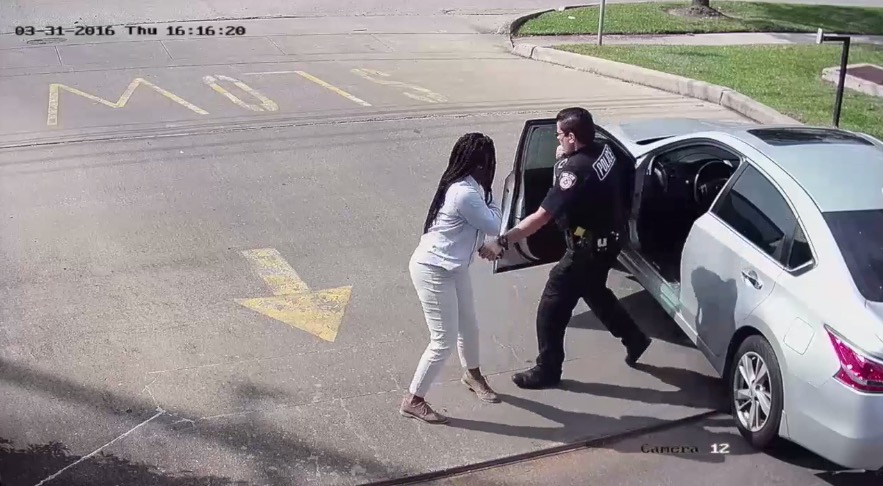
LaPolice reform and oversight neededst week the Houston Chronicle reported the arrest of a therapist last March for resisting arrest. When she was pulled over for allegedly crossing a double white line, the young woman dialed 911 asking for another officer because she was afraid of the patrol officer who had threatened to taze her.

Was there provocation? Did the Officer use excessive force?

Ms. White’s attorney released the surveillance video video from the area dubbed with the official recording of the 911 call. For several minutes we see the officer standing by, shouting at times, while she calmly talks with the dispatcher. Then, when the dispatcher connects her with the officer’s department, he suddenly grabs his handcuffs and then grabs her. There appeared to be no provocation other than her statement to his supervisor that the officer was harassing her. She yells that he is trying to break her arm and we see parts of the struggle that ensues. The dispatch tape indicates that she rapidly goes from calm to incoherent as he manhandles her.

Conflicting Expectations

Ms. White screams, “Please get your hands off of me. What is wrong with you? … Why are you doing this?…I am a woman.” It was obvious that she expected to be treated with respect.

The officer was cleared by the department. They said that he was trained to be wary and he acted properly.  From their standpoint, she should have gotten back in the car. Her failure to do that, justifies the manhandling and charges.

If she is convicted, the newspaper reports that she could lose her livelihood.

De-escalation and solutions

This video is less violent, when compared to much more egregious examples of police action since cell phone video began wide use. Ms. White wasn’t killed or badly hurt. It seems that changes in policing systems and police actions are needed. Police are called on to deal with people on their worst days. We call the police when our neighbor flips out or when we can’t deal with one of our relatives in the midst of a mental crisis. Officers receive very little, if any training, in de-escalation.

Several recent federal reports indicate the problem is not so much bad officers as a broken system.

In addition to the long list of situations that we ask police officers to handle that they are not trained to do, reports on individual police departments indicate that the system is broken.

This week the Justice Department issued its report on Baltimore PD.  Key findings were that the PD’s system targeted African-Americans and failed to supervise and train officers. It called out “zero tolerance” policing and said it often resulted in violations of the Constitution. Under that program officers reported about 300,000 stop and frisk incidents in a five year period. Yet, an audit showed that in 2014 alone, there were more than 400,000 stops in a city of about 625,000.

Some examples are telling. The report cites one middle aged  black man who was stopped 30 times in four years and never cited for anything. In addition, investigators also found evidence that some department  leaders ordered officers to target black residents.

The attitude of the brass became crystal clear when one of the Justice Department investigators did a ride-along. The supervisor pointed to several black men standing on the sidewalk and told the patrol officer to stop and question them; then disperse them. The officer protested that he didn’t have a reason to do that. His boss’s reply was: Think something up.

Lax oversight, an us vs them mentality

The  Baltimore report echoes findings in cities and towns across the nation. The ideas for police reform are many and varied. A robust complaint system is often cited. Yet, after reviewing a statistically valid sample of about 850 use of force reports, the feds concluded that supervisors approved all but a handful of complaints that they deemed questionable.

When internal oversight fails to curb abuse, individual citizens and groups can take their complaints to our courts. Lawsuits provide outside scrutiny and high profile examples that contribute significantly to creating the impetus for change.


Can a computer replace your attorney?

Robot lawyer?

Photo credit: CC BY-SA 3.0

by John Groseclose

Robots and artificially intelligent computers have been replacing industrial  jobs for a decade or more. Five years ago many of us saw IBM’s Watson beat two champions on Jeopardy.

Now Watson has given birth to ROSS, billed as an artificially intelligent lawyer. Several law firms have already hired ROSS.

Key components of lawyering cannot be replaced

But can ROSS actually replace the family attorney? I think the answer is a qualified no.

ROSS may be able to speed up legal research and stay on top of new case law better than attorneys, particularly in obscure areas of the law. ROSS cannot, however, provide the support you may need when disaster strikes and you are overwhelmed by all the unfamiliar tasks and decisions. ROSS can’t empathize either.

Insurance companies are already using artificial intelligence in making decisions, when you file a claim. Some colleagues are even speculating that in the not too distant future, insurance companies may use artificial intelligent devices. What if they sent a camera with artificial intelligence to pretrial depositions, instead of a lawyer, that could pose questions and film the proceeding. I wonder, though, how good the machine would be with determining which answers are truthful. During the deposition, the machine would be able to change the questions depending on answers. But what about being able assess when more probing is needed based in human interactions, such as inflection and expressions?

Attorneys must make decisions throughout a case based on her knowledge of  typical juries and long experience with the temperament of the judge in the case. Most importantly, how will a computer judge how well you and witnesses will perform on the witness stand. ROSS cannot replace an experienced attorney’s judgment. American law is a very human activity.

Photo credit: CC BY-SA 3.0, https://commons.wikimedia.org/w/index.php?curid=140450

Our Silverdale office closes

Silverdale, WA


We have closed our office in Silverdale, WA. All eight of our attorneys will be available in our Port Orchard office. We will continue to seek an office in north Kitsap County that better meets our needs. It is important to us that are offices are accessible to all of eastern Kitsap County. Continue to contact us at 360-876-9221.

Back the Blue Act guts drive for police reform

civil liability limits

photo of 2015 protest of police brutality by Pax Ahimsa Gethen

Back the Blue Act guts incentives to improve policing

In the past two years we’ve seen example after example of excessive force by police officers. Although they too often result in serious injury and death, these assaults rarely result in convictions or even prosecutions for the officers. In some cases, however, victims or families bring successful lawsuits. These serve, as personal injury lawsuits usually do, to bring changes to business as usual. Lawsuits for police abuse and excessive force are an important part of the drive to reform training and policies in police forces.

Tamir Rice murder: No indictment, $6 million settlement

A good example of these system failures is the murder of 12-year-old Tamir Rice in Cleveland, OH, just five days before Thanksgiving. The prosecutor failed to prosecute. Yet, 17 months later the City of Cleveland reached a $6 million settlement with Tamir’s family. It is too early to see what changes might result in policing in Cleveland.

The new U.S. Senate “Back the Blue” Act seeks to remove civil penalties as a tool to reform police departments.

The “Back the Blue Act” has been offered in the Senate in reaction to the recent fatal attacks on police. The Act increases penalties for harming a police officers, no matter how minor.

Robust civil penalties, a tool for change

This blog has made the point often that personal injury lawsuits help improve safety for all of us. Limits on compensation undercuts the ability to hold law enforcement accountable for horrible harm it sometimes inflicts.

Robust civil penalties for police misconduct and excessive force are particularly important. It is much more difficult to prosecute a law enforcement officer for assault or murder than to prosecute a civilian. Separate criminal laws for law enforcement personnel give them wide latitude in the use of deadly force. Although these laws, along with improved training, are currently under review, right now criminal law offers little help to end police attacks. Right now civil lawsuits remain the key tool available.

Back the Blue in its entirety is a gross overreach to address assaults on police officers. Federal law already addresses assaults on law officers. If the law passes, police officers who use excessive force  will continue to escape prison and there will be little access to the courts for victims. The best way to address the recent problems with assaults on police is to quickly move to reform.

John Groseclose, Partner, GSJones Law Group, P.S.

Military hospitals – medical malpractice

medical malpractice

Should military hospitals be liable for gross medical mistakes, for medical malpractice? A case with local ties once again asks that question in the heartbreaking death of Navy Lt. Rebekah Moani Daniel in childbirth.

She entered Navy Hospital Bremerton in March of 2014 with her husband Coast Guard Lt. Cmdr. Walter Daniel. According to the details provided by the Kitsap Sun she bled to death after an easy birth of their daughter, Victoria. Among other medical errors the lawsuit charges that a hospital doctor waited 90 minutes past the standard set to order a transfusion. Yet, Lt. Cmdr. Daniel is barred from suing the hospital for this egregious error.

This death is tragic and simple compassion makes us all long for justice for Walter and his daughter. Justice is certainly a reason for suing, when we are harmed by someone’s carelessness or incompetence. Yet, these personal injury and medical malpractice lawsuits are the means to set penalties for malpractice.  They motivate medical facilities to make changes in their practices that will increase the safety of all of us.

Workers Compensation and Medical Malpractice

In 1950, the Supreme Court ruling in Feres prevents troops from suing the government for injuries deemed incidental to military service. How is the birth of a baby “military service”? Courts and the government argue that the military equivalent of civilian workers compensation provides sufficient compensation for injuries due to medical malpractice. Workers compensation prevents civilian workers who are injured on the job from suing their employers in exchange for payments from the insurance fund. Yet, nowhere in civilian employment are medical malpractice injuries covered by workers comp. Thus, this discrepancy can translate to less accountability in military hospital practices.

Did an attorney fail to take your case?

The attorney in this case is taking a real chance in bringing suit, as is the husband. Our court system requires that previous decisions by the Supreme Court sets the rule in similar cases. The person suing can be charged for the expenses of the winning side, if the judge decides that there was no basis to file the lawsuit. Lawyers take personal injury cases without charge, taking a percentage of the ultimate court award. The number of hours an attorney can put in can mean financial ruin for him or her. So they take a serious risk when they take on a case with an established Supreme Court rule.

Each attorney makes an individual assessment. If one lawyer won’t take your case, whether injuries from an auto accident, a slip and fall, a faulty product or medical malpractice, consider asking another experienced personal injury attorney about your case. The initial consultation is always free.

John Groseclose, Partner, GSJones Law Group, P.S.


Are Judges solely responsible for biased judicial decisions?

Judicial bias

by John Groseclose, Litigation Attorney

In the national debate about mandatory minimums, biased judicial decisions and whether a judge should have discretion in sentencing someone that is found guilty or pleads guilty to a crime, it is very difficult to compare what occurred.  I have been told that one of the most effective methods of activism is to tell stories.

Get the facts to the public and then the public can help campaign for change. The explosion of social media and our digital society allows a pretty good platform.


There was a great blog post I saw that compared the Stanford swimmer (white) with the Nashville athlete (African American).  One person faces 6 months and the other 15 years.  Guess which athlete faces the harshest punishment?

A lot of factors lead to a judge’s sentencing decision

Yet, is it that simple? This article examines the differences in the law in the two communities, as well as the differing actions of the prosecutors.

It is too simple to just look at what the judge does.  We all need to look at how the police investigate crimes and how prosecutors make charging decisions.  Some reports have pointed out that the judge in the Stanford case has a record of following the recommendation of the pre-sentencing reports. There are plenty of data to indicate racial bias at every level of the criminal justice process.

The end result (A sentencing) is the result of decisions made at every level. Reform and change start at the bottom of the pyramid which still needs a lot of work. And all of us have responsibility for the changes needed.

U-Visas for undocumented crime victims and families

U.S. U-Visa

By Michele Taylor, Immigration and Criminal Defense Attorney

Please help spread the word, U-Visas are for undocumented crime victims and their families. They allow the U-Visa holder to work and remain in the US for 4 years and also qualify immigrants to apply for permanent resident status. Undocumented folks are often targeted by criminals because they believe that without papers the victims will be too afraid to report the crime. It has been reported that many victims of the Orlando massacre were immigrants from Puerto Rico and some may be without documentation.

Although it takes a great deal of courage, reporting the crime and assisting in prosecution can mean that you can be granted a visa and permanent resident status. Your parents, children and spouse may also qualify. When you report crimes to authorities you help the whole community by helping to reduce crime. If the crime resulted in the death of a close family member surviving family members may also receive U-Visas.

You will usually have better results with an experienced immigration attorney at your side, particularly one with experience with the criminal justice system. The process requires law enforcement who is handling the criminal case to verify the crime and your help. Understanding of the role of law enforcement in the process varies greatly among different law enforcement agencies. Many undocumented crime victims report that their U-Visa applications are never processed by the police. If you decide to go it alone, you may print this document from the Department of Homeland Security that educates law enforcement about their duty in the process. Be prepared to find a way to exert pressure over the law enforcement agency. They are far more likely to just not process the form than to deny it outright. This is an important way that an attorney can make a big difference.

The document also lists most of crimes that apply. Please note that one of those crimes is peonage which is  forcing people to provide free labor to pay off real or imagined debt. It also applies to survivors of domestic violence. Contact us if you have a question about whether or not you qualify.

Chalmers Johnson settlement for “trash out” victim

GSJones Law Group, Chalmers Johnson, was featured on a recent KOMO TV news segment on the illegal activities of “trash out” companies. Chalmers negotiated a settlement with Safeguard Properties for Byron Brassfield of Port Townsend. There are dozens of lawsuits against Safeguard filed every year for illegally entering foreclosed properties while the owners are still legally in possession and throwing away all the owners belongs, including mementos, photos and in one case even the urn containing a loved one’s ashes. Byron’s home was not even foreclosed when they broke into it and took everything to the dump.  Click here for the news story.

Chalmers loves getting compensation for people who have been injured or suffered serious wrongs. He would love to talk with you, if you need a strong attorney who will fight for you.

John Groseclose, Kitsap County neighbor

Meet John Groseclose, Kitsap County neighbor

Meet John Groseclose, one of your Kitsap County neighbors at the GSJones Law Group in Port Orchard and Silverdale, where he is a partner. He is an active member of the community, currently serving as the president of Kitsap Legal Services. He joined the board five years ago after volunteering for several years. The housing justice project, which he helped to form, is a particular favorite. “I was concerned that there was no way in Kitsap County to help people who were being evicted. Kitsap County lacked the clinic available in nearby counties,” he said. Continue reading